


Certificate III vs Certificate IV in Aged Care & Disability
July 14, 2026
What Does a Career in Aged Care Actually Look Like? A Week in the Life
A career in aged care doesn't get talked about much until someone you love needs it, or until you're standing at a crossroads, trying to work out what a genuinely meaningful job actually looks like day to day. This is what a career in aged care really involves: the roles you could do, what a typical week looks like, the parts nobody puts in a brochure, and the qualification path to get there.
This isn't one specific person's diary. It's a fair, composite picture built around real course structures and real job outcomes, not a sales pitch.
What Does a Career in Aged Care Actually Involve?
At its core, a career in aged care means supporting older Australians to live safely, comfortably, and with dignity, whether that's in a residential aged care home, in someone's own home through community care, or somewhere in between.
The work happens across a few different settings:
- Residential aged care — working within a facility, supporting a group of residents through a structured roster of shifts.
- Home care — visiting clients in their own homes, usually working more independently and building a closer one-on-one relationship.
- Community and social support — helping people stay connected, active, and engaged outside the home, from transport to social activities.
None of these are "easier" than the others — they just ask different things of you. Residential work leans more on teamwork and structure; home care leans more on independence and relationship-building.
The Different Roles You Could Do
"Aged care worker" covers more ground than people expect. Depending on your qualification and experience, a career in this field could look like:
- Personal Care Worker / Support Worker — the frontline role, providing hands-on daily support. This is where almost everyone starts.
- Care Team Leader / Care Supervisor — overseeing a shift or a small team of support workers, usually after a Certificate IV.
- Community Program Coordinator — organising activities, programs, and services for a group of clients.
- Case Coordinator / Community Care Manager — managing individual care plans and coordinating services across a caseload, typically a diploma-level role.
The point is, this isn't a dead-end job. It's a career with a genuine ladder, and you can see exactly where each qualification takes you (more on that below)
A Week in the Life: What a Typical Shift Actually Looks Like
Monday: The Morning Shift
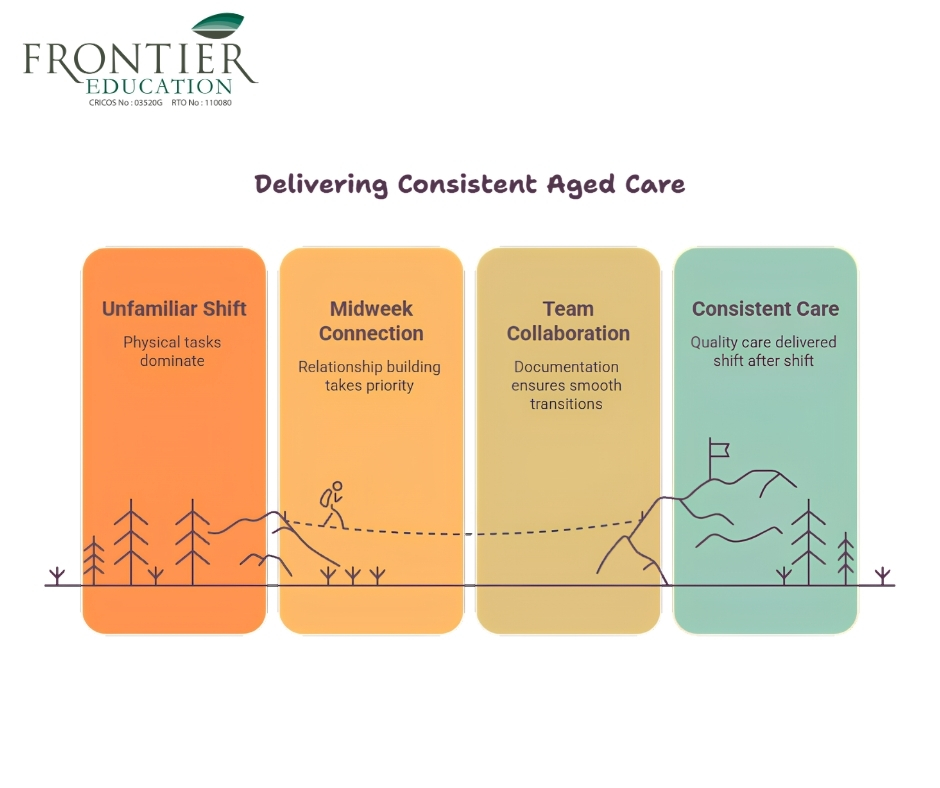
Most shifts start early, somewhere between 6 and 8 am. You arrive, get a handover from the overnight team- any falls, any changes, anything to watch- and then you're straight into it: helping residents or clients get up, wash, dress, and manage their morning medication if that's within your scope. There's no easing into an aged care shift.
Breakfast is often the real start of the day, and not just for the person you're supporting. It's usually the first proper conversation of the shift, and it tends to set the tone for everything after.
Wednesday: The Moments That Actually Matter
By midweek, the physical tasks, personal care, mobility support, and help with meals start to feel familiar. What doesn't feel routine is the relationship side of the work. Sitting with someone who wants to talk about their life. Noticing that a resident's a little quieter than usual and checking in properly, not just ticking a box. Helping someone living with dementia feel safe and oriented, even when the day or the year has slipped from them.
This is the part that never makes it into a course brochure, and it's usually the part people end up caring about most.
Friday: Teamwork, Handovers, and Getting It Right
Aged care is never really a solo job. You're one part of a wider team, other support workers, a team leader or supervisor, nurses, allied health staff, and Friday afternoons often mean documentation: recording what happened through the week, flagging anything for the weekend team, making sure nothing gets missed. It's not the glamorous part of the job, but it's exactly how good, consistent care gets delivered shift after shift.
What Skills Do You Need for a Career in Aged Care?
You don't need a clinical background to start; that's what the qualification is for. What genuinely helps:
- Patience — some days move slowly, and that's fine.
- Physical stamina — you're on your feet, and the work is hands-on.
- Communication — with clients, families, and a wider care team.
- Emotional resilience — you'll support people through hard moments, including loss.
- Cultural sensitivity — aged care in Australia means working with people from a huge range of backgrounds.
Most of this develops on the job. What a qualification gives you is the foundation for the "what to actually do" so you're not guessing in the moment.
The Honest Bit: It's Physically and Emotionally Demanding
No article about a career in aged care is complete without saying this plainly: it's hard work. You're on your feet for most of the shift. You'll support people through some genuinely difficult moments, including loss. It asks a lot of your patience, and a lot of your body.
What people who stay in the industry tend to say is that the demanding parts are also where the job finds its meaning, and that proper training beforehand, rather than learning everything on the fly, makes a real difference to how confident and capable you feel when those moments come.
Your Career Pathway: Certificate III → Certificate IV → Diploma
The genuinely good news about a career in aged care is that the pathway is clearly mapped out ; you're never guessing what comes next.
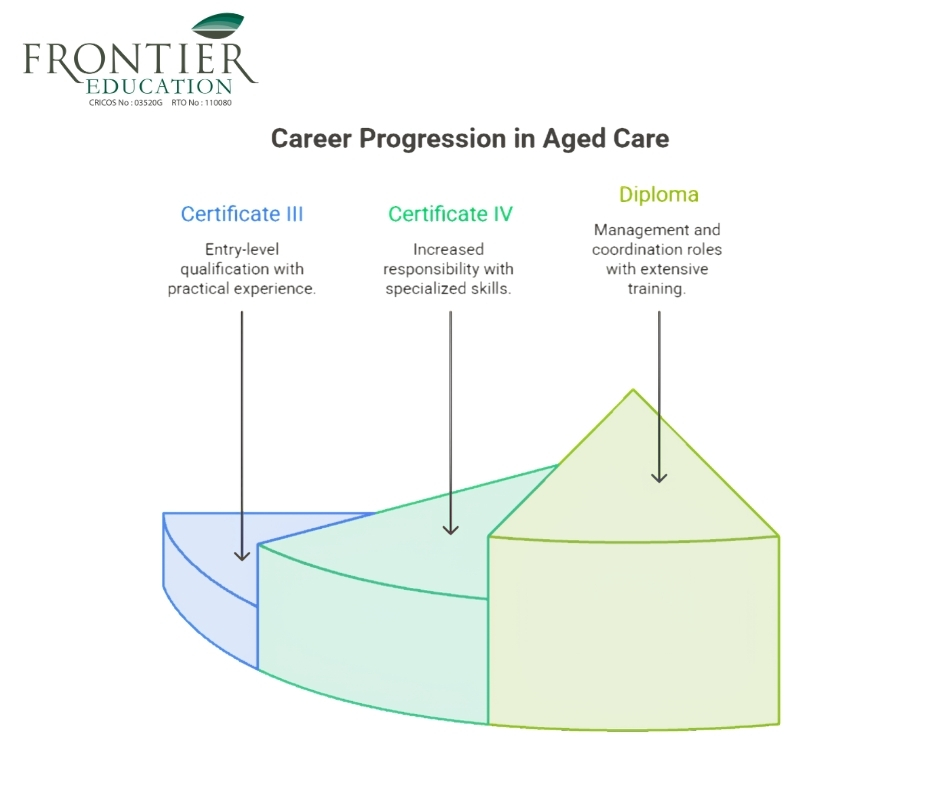
CHC33021 Certificate III in Individual Support (Ageing and Disability) is where almost everyone starts. It's a 52-week, nationally recognised qualification with at least 120 hours of supervised work placement built in, so you're getting real experience alongside the classroom learning. It's the standard entry point into support worker, personal care worker, and residential care roles.
CHC43015 Certificate IV in Ageing Support is the natural next step for people who want more responsibility. It's another 52 weeks, with 150 hours of placement, and a curriculum built around service planning, dementia care, and falls prevention. It opens up roles like Care Team Leader and Care Supervisor.
CHC52025 Diploma of Community Services is the step for people aiming at management or coordination. It's a longer qualification (104 weeks, with 200 hours of placement) built for case management, program coordination, and supervising other workers. Graduates typically move into roles like Community Care Manager, Case Coordinator, or Community Services Coordinator.
You don't have to decide your ceiling on day one. Plenty of people work for a while after Certificate III before deciding whether to keep climbing.
Why Now Is a Good Time to Start This Career
Australia's population is ageing, and the need for skilled, properly trained aged care workers isn't slowing down. It's one of the few industries where a nationally recognised qualification carries real, immediate weight with employers , because it signals you've actually been trained for the role, not just handed a shift and told to figure it out.
Studying This Career as an International Student
All three qualifications, Certificate III, Certificate IV, and the Diploma Community Services, are CRICOS-registered, so they count as approved study for international students on a student visa. All three are delivered at Frontier Education's Brisbane and Cairns campuses. English requirements step up as you go: IELTS 5.5 for the Certificate III, and IELTS 6.0 for the Certificate IV and the Diploma (or equivalent). With multiple intakes across the year, you're rarely waiting long to get started.
Frequently Asked Questions About a Career in Aged Care
Do I need experience to start a career in aged care?
No. The Certificate III in Individual Support is designed as an entry point, no prior aged care experience is assumed.
How long does it take to qualify?
The Certificate III takes 52 weeks. Going on to the Certificate IV adds another 52 weeks, and the Diploma of Community Services runs for 104 weeks.
What's the difference between Certificate III and Certificate IV?
Certificate III focuses on hands-on, individual support. Certificate IV adds service planning and leadership-adjacent skills, and typically leads to Care Team Leader or Care Supervisor roles.
Can I work while I study?
Work placement is a compulsory, built-in part of every course, it's how you get real hours in the field before you graduate, not something separate from your study.
Is a Career in Aged Care Right for You?
Some jobs you take because they pay the bills. This one, most people end up staying in because of who it makes them on a hard day, patient, present, genuinely useful to someone who needs it. If reading through this felt more interesting than exhausting, that's usually the sign worth paying attention to.
Your next step depends on where you're starting from:
- New to the field? Start with Certificate III in Individual Support (Ageing and Disability).
- Ready for more responsibility? Look at Certificate IV in Ageing Support.
- Aiming for management or coordination? The Diploma of Community Services is the one to look at.
Whichever fits, enquire with Frontier Education, and a study advisor will help you find the right starting point — including whether Brisbane or Cairns suits you better.